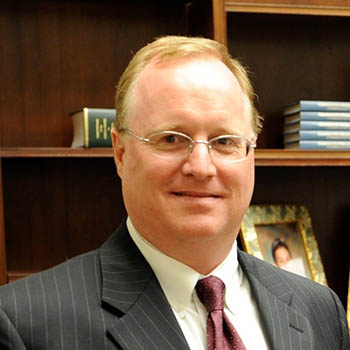
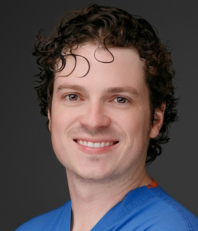
Program leadership and core faculty you'll know by name — individualized learning plans, weekly contact, and feedback that actually compounds across rotations. You'll be known from your first week.

Program Director of the UCSD Clinical Informatics Fellowship. Oversees program design, ACGME accreditation, recruitment, and fellow progression. Focus areas include ED informatics, AI/ML in clinical workflows, and fellowship pedagogy, with a particular interest in medical education informatics.

Associate Program Director with longstanding leadership in UCSD Health's informatics enterprise. Focus areas include inpatient workflow, clinical documentation, and EHR-based quality measurement.

Associate Program Director with deep expertise in clinical decision support, diagnostic error, and the implementation science of CI interventions.
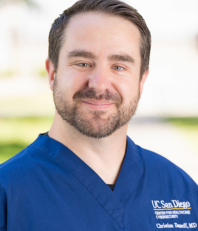
Emergency physician, clinical informaticist, and security researcher — a national voice on healthcare cybersecurity and patient safety. Co-founder of the CyberMed Summit and co-director of the UC San Diego Center for Healthcare Cybersecurity; his work spans the clinical impact of ransomware, medical-device security, and 911/EHR vulnerabilities.
Beyond program leadership, a group of core faculty teach, precept, and mentor fellows week to week — the people you'll actually build alongside across rotations and scholarly projects.

Pediatrician and clinical informaticist serving as Chief Medical Information Officer at Rady Children's Hospital San Diego. His published work centers on EHR-based quality improvement — standardizing pediatric medication reconciliation, measuring clinician EHR workload — and on training clinicians through clinical informatics education.

UCSD's inaugural Clinical Research Information Officer and a two-decade veteran of medical informatics, elected to the American College of Medical Informatics. Deep expertise in terminologies and NLP, research data infrastructure, and public-health informatics — including statewide systems like California's integrated vital records.

Emergency physician and health-information-exchange architect, and founding director of the UC San Diego Clinical Informatics Fellowship. Designed and built UCSD Health's first HIE linking community clinics to UCSD for shared records, the San Diego EMS Hub that streams EMS patient records and EKGs to hospitals in real time, and served as lead architect for the ONC-funded San Diego Beacon Project behind the regional HIE. Continues as Chief Medical Officer of San Diego Health Connect.

Family-medicine physician working on AI in primary care — physician attitudes toward clinical AI, EHR-integrated dementia-care algorithms, and In Basket workload. His work spans the operational side of informatics too, using CDS and EHR optimization to streamline workflows with the end user always in mind. Grounds fellows in what it takes to bring informatics tools into a busy primary-care practice.

Clinical Professor and primary-care informatics leader focused on ambulatory workflow, patient–clinician communication, EHR usability, and physician well-being. Has led work on AI-drafted patient messages and In Basket burden — the day-to-day realities of making the EHR work for clinicians.

Minimally-invasive and bariatric surgeon who directs peri-operative informatics, and co-directs surgical quality for UC San Diego Health and the Surgical Quality & Informatics Fellowship; Jeff brings a critical surgical perspective to informatics.

Inaugural Chief Health AI Officer for UC San Diego Health, leading AI strategy and governance for the health system and AI initiatives within the Jacobs Center for Health Innovation. A national voice on the safe evaluation and deployment of predictive and generative models — from sepsis prediction to LLMs — and the faculty anchor for fellows working on clinical AI.

Clinical Professor whose work centers on population health informatics, precision medicine, and using the EHR to close gaps in care and equity. Long track record building registries, quality-measure pipelines, and clinically integrated data programs — the operational side of informatics fellows learn to run.

Anesthesiologist and security researcher focused on the intersection of medical technology and patient safety. Co-director of the UC San Diego Center for Healthcare Cybersecurity and co-founder of the CyberMed Summit; his research spans HL7 exploitation, compromised-device simulation, and the clinical fallout of ransomware and IT outages.

Hospitalist and clinical informaticist working at the intersection of inpatient care and machine learning — from deep-learning models for physiological deterioration to AMIA work on inclusive language in biomedical informatics. An active mentor in the hospital-medicine and informatics education pipeline.

A proud first-generation college graduate, born in Peru and raised in Miami, Ruth found her calling in equity-driven care while working as a Patient Navigator at a free clinic and conducting preventive health research. At UCSF she co-founded a medical Spanish elective, helped develop the Global Surgery & Health Equity curriculum, and researched with the Center for Health Equity in Surgery and Anesthesia (CHESA) — work spanning pediatric surgical access, health systems strengthening, and social vulnerability indices in surgical outcomes. Her informatics interests center on leveraging data to advance perioperative equity, surgical quality improvement, and documentation efficiency, with a focus on EHR-integrated risk stratification tools and embedding language concordance and social drivers of health into surgical workflows. Outside the hospital she enjoys weightlifting, creating art, sewing, hiking, and exploring.

Born and raised in Karachi, Pakistan, Ayesha trained at Dow University of Health Sciences before moving to the United States and completing her family medicine residency in West Virginia. She co-founded OneClinic, a telemedicine company expanding access to care in rural communities, and helped develop a patented telemedicine platform and remote examination kit — work that earned a USDA grant and recognition from the governor of Ohio. Having worked across outpatient clinics, emergency departments, and inpatient units, she is especially interested in optimizing primary care workflows at scale, with interests spanning artificial intelligence, clinical decision support, workflow optimization, health equity, and timely access to care. Outside medicine she enjoys traveling, discovering memorable food, and spending time with her daughter — her favorite things about San Diego are its beaches and finding the perfect meal after a day by the ocean.

Mohanad is from Saudi Arabia and earned his MD from King Saud University College of Medicine. He completed his diagnostic radiology residency and a neuroradiology fellowship at UC San Diego, along with a Master's in the Leadership of Healthcare Organizations (MAS), and is now a Clinical Informatics fellow at UCSD. He was drawn to informatics after realizing that some of the biggest gains in patient care come not from reading one more scan, but from improving the systems and workflows behind every order and interpretation. His interests include responsible AI in healthcare, imaging informatics, clinical decision support, and health data governance. Outside of work, he'll take San Diego's weather, coastline, and food scene any day.

Yash's path into informatics began at Princeton's School of Public and International Affairs, where he studied how federal reimbursement policy differentially shaped hospital uptake of emerging technologies such as telemedicine. His subsequent work at UCSF in breast surgical oncology centered on clinical trial management and a patient-facing digital decision aid, and a degree from the UC Berkeley School of Public Health further integrated his interests in informatics, policy, and decision making. His fellowship work focuses on improving how patients and surgeons make decisions in the perioperative space using clinical informatics tools — including wearable devices and ambient monitoring — with the goal of improving the efficacy of perioperative care at UC San Diego Health. An avid photographer, he is drawn to San Diego's stunning landscapes and also enjoys hiking, graphic design, winetasting, and the region's beaches and food.
Two fellows graduate each year and step into academic, clinical, and operational informatics roles — many of them staying on as UC San Diego faculty. Below: where recent graduates are now.
Fellowship Coordinator. Day-to-day program operations, ERAS application support, fellow onboarding, scheduling, and ACGME paperwork. The first person you'll speak to during the application process.
Reach the program coordinator for eligibility questions and application logistics. The Apply page has the full timeline and FAQ.
Interviews happen in the fall after ERAS opens. Questions before then? Reach the program coordinator.